
- All focus groups supported ecosystems as carbon stocks, often comparing them favorably to the resource and infrastructural costs of engineered systems, motivated by naturalism, familiarity, and agency.
- Food security, residential space, and property seizure were key context tying together all carbon removal approaches with land-use implications.
- Focus groups saw engineered approaches as centralized, supply-driven cooperation between government and industry; a sense of agency was muted.
- Focus groups from countries with more positive perceptions of government-industry collaborations (e.g. visibly successful state-owned enterprises, and/or a highly functioning, well-regulated technology sector) tended to speak of engineered approaches more favourably.
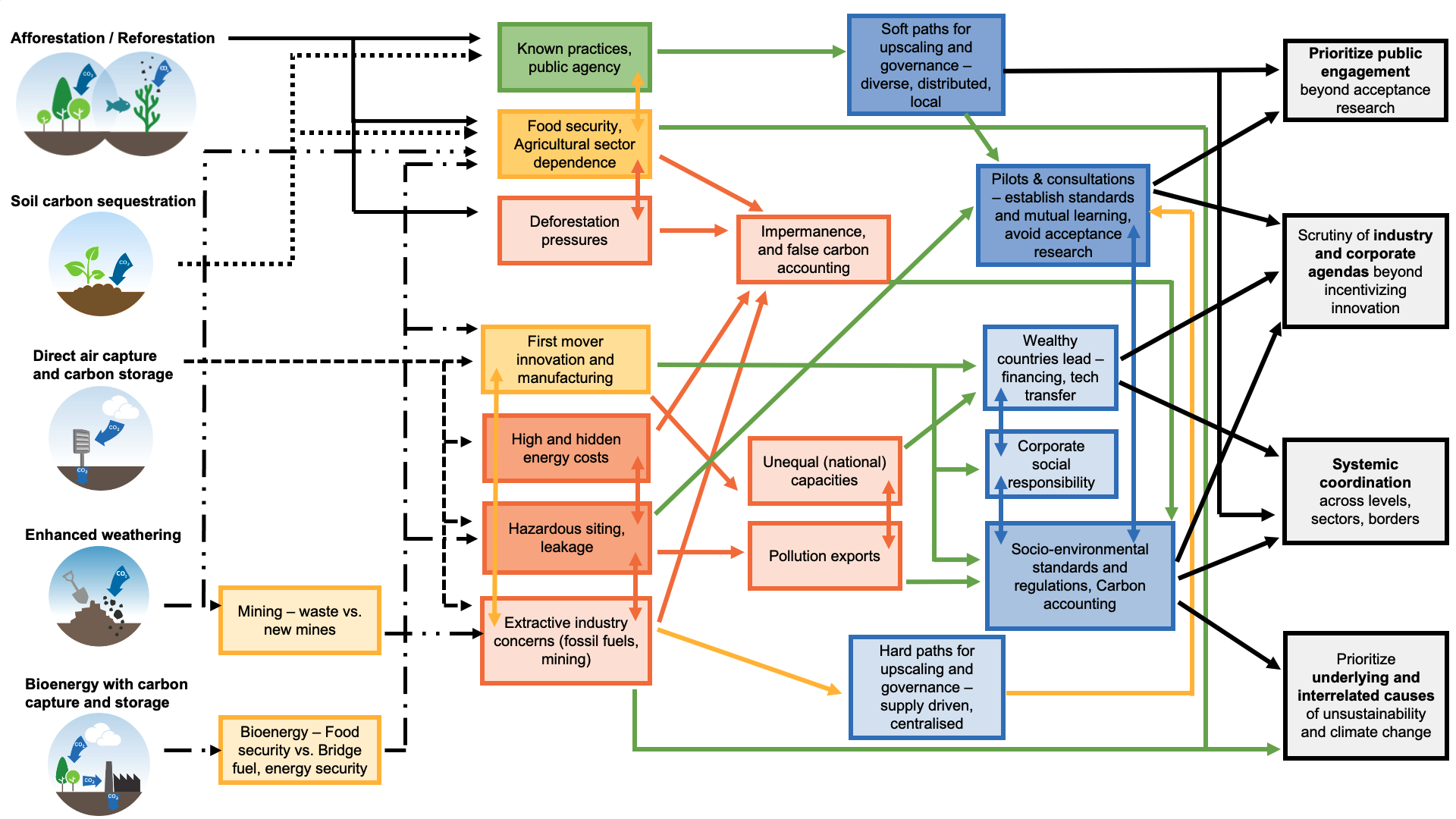
- We highlight four rationales to guide further assessment: (i) public engagement should go beyond acceptance research; (ii) scrutiny and regulation of industries in carbon removal should be developed beyond incentivizing innovation; (iii) governments must foreground transboundary dimensions; and (iv) researchers and policymakers must prioritize underlying and interrelated causes of unsustainability and climate change.
Carbon removal – the development, upscaling or utilization of a diverse range of carbon sinks – is emerging as a pillar of governmental and industry commitments toward achieving Net Zero emissions reductions targets. How do a global range of publics across the Global North and South – represented by deliberative focus groups – perceive the prospective benefits, risks, and governance of five forms of carbon removal, ranging from ecosystems (forestry, soils, marine ecologies) to large-scale engineered and industrial methods?
Our study follows a prior survey-based study as part of a mixed-methods framework – with the survey sourcing nationally-representative preferences, and focus groups uncovering underlying reasoning and in-depth politics.
We engage with 44 focus groups (1 urban, 1 rural) in 22 countries, representing every inhabited continent and all UN regions (9 in Europe, 1 in North America, 3 in Latin and South America, 3 in Africa, 2 in the Middle East, and 4 in the Indo- and Asia-Pacific). These further represent the Global North (Australia, Austria, Germany, Switzerland, Poland, Spain, Italy, Norway, Sweden, the United Kingdom, and the United States), the emerging Global South (South Africa, India, China, Indonesia, Chile, Brazil, Turkey, and Saudi Arabia), and the developing Global South (Kenya, Nigeria, and the Dominican Republic).
We find that all focus groups supported ecosystems as carbon stocks, often comparing them favorably to the resource and infrastructural costs of engineered systems. Participants were strongly swayed by the well-known naturalism bias (perceived as being “natural”, or a “part of nature”), as well as by agency: these approaches were seen as easy to technically grasp, had varied and distributed applications, and ordinary citizens could personally participate in upscaling (e.g. as farmers or landowners), through civic initiatives, or alongside municipal or local government. Groups – especially in tropical forested countries – connected afforestation and reforestation efforts to banning or disincentivizing deforestation. Urban opportunities were noted across North and South contexts: rooftop and vertical gardens, city zoning and construction laws requiring green areas and components, and co-benefits for urban health and air pollution. Many trade-offs in using land for carbon stocks: a trade-off with food crops and leading to concerns of food security, as well as competition with residential development, driven by widespread perceptions of insufficient housing developments or distributed, space-intensive private property.
Compared to ecosystems-based approaches, participants found DACCS more difficult to grasp technically, while seeing its infrastructure, energy needs, and siting as emerging from centralized, supply-driven cooperation between government and industry. A sense of agency and direct participation was muted. Focus groups from countries with more positive perceptions of government-industry collaborations (e.g. visibly successful state-owned enterprises, and/or a highly functioning, well-regulated technology sector) tended to speak of this more favourably. These included China, India, Saudi Arabia, Norway, and Switzerland. Conversely, participants with more negative perceptions of government-industry collaborations worried about the social costs of developing a high cost, high energy infrastructure. Another concern was on unequal technological and financial capacities, where state funding for innovation would compete with other uses of public funds.
In closing, we highlight four rationales to guide further assessment.
Firstly, assessment and decision-making should prioritize public engagement, going beyond acceptance research that treats publics as consumers of carbon credits or products, or as adopters for whom carbon removal must be ‘de-risked’. This would work towards widely held public imperatives of agency, of those affected being involved in governance, and of tendencies towards trust in local governance processes. For more insights into public engagement, read this related post.
Secondly, scrutiny and regulation of industries in carbon removal should be developed beyond incentivizing innovation. Publics discussed the Polluter Pays Principle more expansively as ‘polluters should take responsibility’. Concerns included industry-governmental collusion and corruption, profit-seeking motives undercutting local co-benefits, carbon storage safety and permanence, and hope that that costs and harms should not be passed to citizens (e.g. hazardous siting of infrastructure, land-use trade-offs, and land/property appropriations) or to other countries (pollution exports of stored carbon).
Thirdly, all countries must foreground the latent transboundary dimensions of carbon removal. At a broad level across carbon removal approaches, these include: (re)evaluating ‘fair shares’ of the carbon budget, distributing different kinds of carbon removal and components of international supply chains, separating targets for emissions reductions and carbon removal, clarifying definitions of hard-to-abate and other categories of emissions that implicate offsets, and separating biogenic carbon removal from offsetting industry emissions – all in light of the potential for bilateral and multilateral trading of carbon credits.
Finally, both researchers and policymakers must prioritize underlying and interrelated causes of unsustainability and climate change. The management of agriculture and forestry as carbon stocks – linking further to diverse ecosystems management practices – implicates food security and biodiversity. Industrial approaches implicate energy governance, security, and accessibility, as well as corporate governance. The transportation and storage of carbon cover a range of logistics and locales that extend from land-based reservoirs to the ocean floor. Carbon removal development may be an opportunity to integrate the governance of entwined global issues. We discuss this aspect in greater detail in this related post.
References
Low, S., Fritz, L., Baum, C.M., Sovacool, B.K (2024)
Nat Commun 15, 3453