
- Nationally varying degrees of perceived personal harm from climate change and climate worry predict support for carbon removal and solar geoengineering.
- Public perceptions are embedded in three narratives about transformation pathways, each reflecting varying notions of responsibility: behavior change-centred pathways, top-down and industry-centred pathways, and technology-centred pathways.
- Support for these technologies hinges on them being tied to system-wide decarbonization efforts as well as on their ability to effectively respond to a variety of climate impacts.
- Prioritizing climate policies and action that tackle root causes considered key.
Publics assess and judge climate policies against the backdrop of their beliefs about the nature and severity of the problem of climate change, their levels of concerns and their emotions regarding climate change. Does this also hold true for how publics make sense of and support novel climate technologies?
In our recent mixed methods study we examine the role that climate change beliefs and attitudes towards climate action play in the formation of public perceptions of for carbon dioxide removal (CDR) and solar radiation modification (SRM). Relying on qualitative data from 44 focus groups, triangulated with survey data from 22 countries, we show that perceptions need indeed be understood in the context of publics’ varying interpretations of the severity and impacts of climate change, of the causes of and perceived responsibilities for climate change, and of what desirable and/or plausible transformation pathways look like.
In the following, we summarise our key take-aways for governance of these emerging climate technologies.
Important national variances exist in the extent to which publics perceive climate change as a direct and present threat or as distantly removed in time and space. In most focus groups, particularly in the Global South, climate change is no longer perceived as distant in time and space, but rather tangibly unfolding and affecting livelihoods. In contrast, conceptions of climate change as a threat distant in time and space were prevalent particularly in Northern European countries such as Norway and Sweden. While participants were worried about climate change in these countries as well, they were less concerned about how it harms them personally. Whether the comparatively low levels of expected personal harm from climate change in these countries reflect perceived high resilience and adaptive capacities requires further attention.
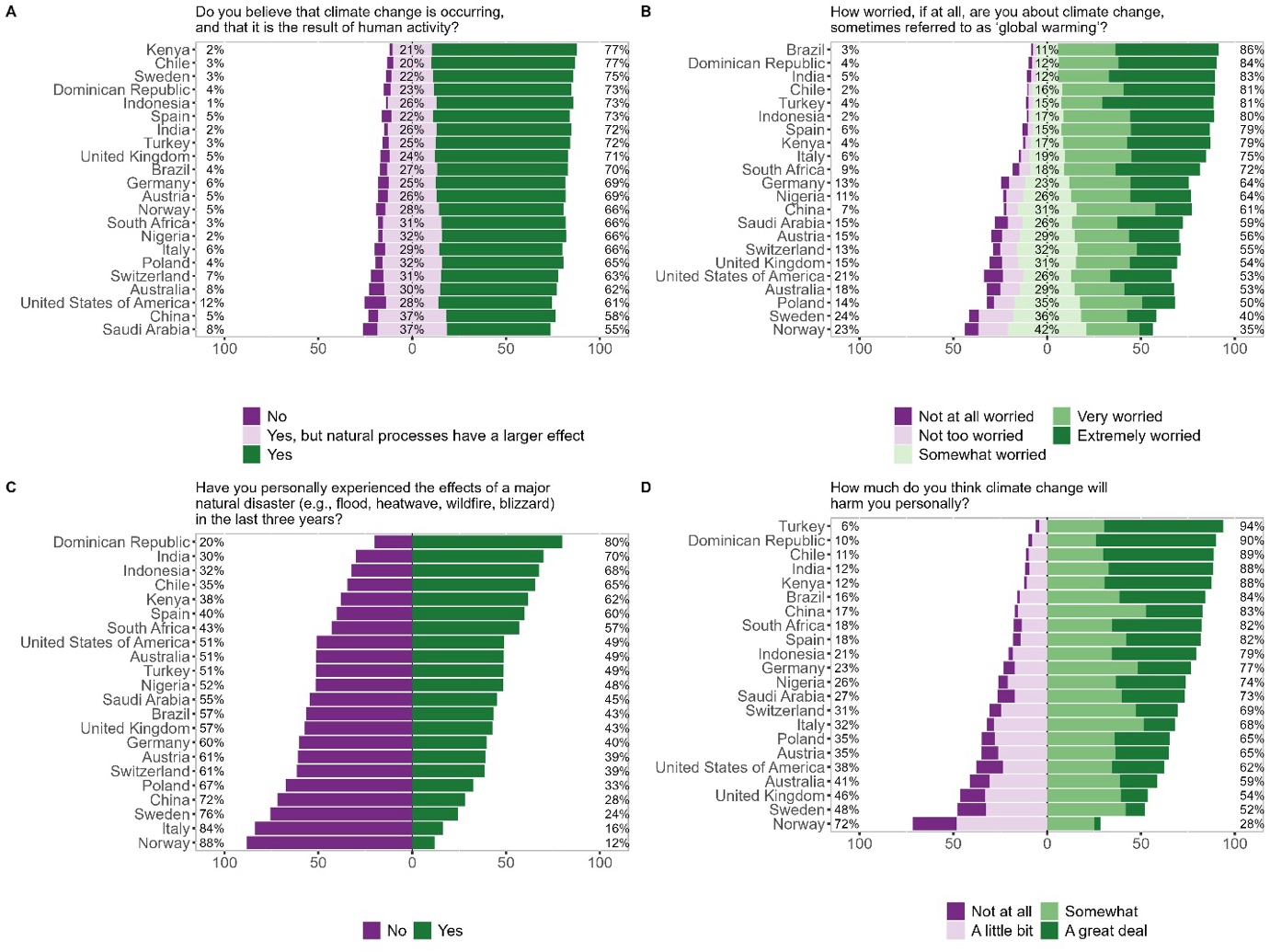
Irrespective of these differences, there is a strong sense of urgency among focus group participants from both Global North and Global South countries, accompanied by frustrations over insufficient levels of awareness and action in the general population and in political realms.
So, how do these evaluations of climate change translate to publics’ perceptions of the climate technologies that we studied?
Overall, we find that climate harm and worry about climate change are robust predictors of public support, particularly for novel, engineered CDR and SRM approaches. The greater the perceived climate harm, the greater the openness of publics to considering climate-intervention technologies. Lasting public support will, hence, also depend on their ability to respond effectively and in a timely fashion to a variety of lived and expected climate impacts.
There does not, however, seem to be a direct translation of the sense of urgency and perceived personal impactedness into outright approval and support for all of the studied climate technologies in the same way. National disparities and technology specificities warrant attention here. Survey participants’ perceptions of personal harm and climate worry emerged as particularly strong predictors for openness to considering SRM and novel CDR technologies, but less so for ecosystem-based CDR approaches.
When considering the qualitative data an even more nuanced picture emerges: the sense of personal impactedness and urgency might not only increase openness to a wide range of measures, but – on the contrary − also translate into concerns that (some of) these technologies would take too long to deliver any notable benefits, either because they have a long lead time (e.g. afforestation and restoration) or because the technology is considered to be infant at best (SRM).
Publics across countries embed their reflections on climate-intervention technologies in wider systems of beliefs, and views on the types and depth of changes needed to tackle climate change. They emphasise different processes and actors as key in such transformation pathways, including individuals, state and industry actors as well as technology developers and innovators. These differences relate to nationally varying notions of responsibility, consumerism and citizenship. Notwithstanding the preferred transformation pathways, publics clearly identify the need for measures and actions that tackle the underlying problem.
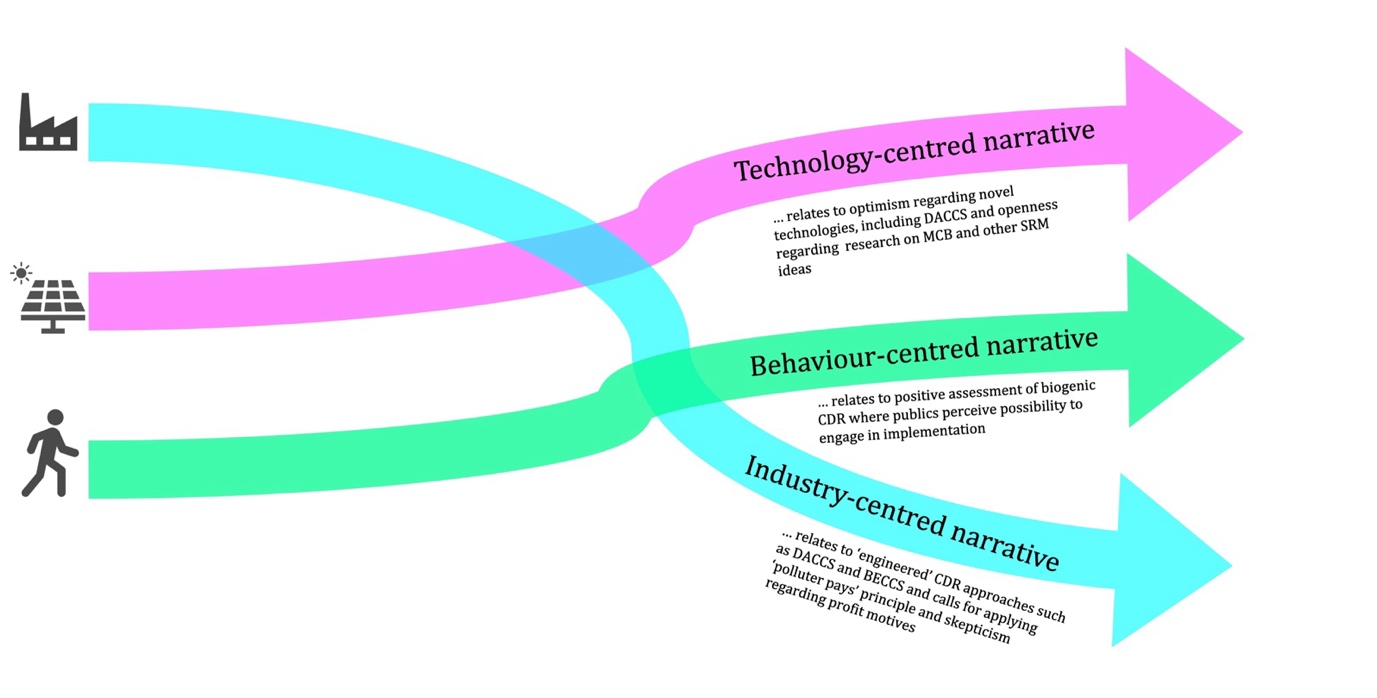
For some, predominantly in Global South countries, CDR is partly envisioned to have a role in such pathways, for others not. In both cases, publics weave CDR options into wider transformation narratives, particularly behavior-centered and industry-centered narratives. SRM is unequivocally criticized for not engaging with the root causes of the problem and appears only in technology-centered narratives of transformation. These results echo earlier reports about CDR as well as SRM being seen as “non-transition”, i.e., as interventions which do not sufficiently tackle the root causes of the problem while potentially bearing new risks and undesirable side effects. These concerns are accompanied by worries over the perverse incentives presented for continued levels of emissions or at least reduced efforts to curb emissions.
Ultimately, public support for climate-intervention technologies, thus, hinges on them being tied to credible climate action that addresses the root causes of the problem.
Read also this related story about public perceptions and support of climate intervention.
References
Fritz, Livia, Chad Baum, Elina Brutschin, Sean Low, and Benjamin Sovacool (2024)
Global Environmental Change