
- Members of the public in 22 countries discussed how they wanted themselves and the wider public to be involved in the governance of climate technologies.
- Public preferences for engagement vary depending on the climate technology in question. Engagement practices need to be tailored to specific technologies and political systems.
- A variety of rationales underpin participants’ narrations of why publics should or should not engage with climate technologies.
- Developing inclusive public engagement necessitates a critical interrogation of past and present forms exclusion and power dynamics in decision-making processes.
- There is a need for engagement processes that value debate and negotiation and that constructively engage with tensions and conflict.
Addressing inter-connected socio-ecological problems requires transformations that enable scientists, governments, industry, local communities and the public at large to effectively collaborate and navigate conflicting values and trade-offs.
As the climate crisis accelerates and its impacts become increasingly tangible the development of responsive and inclusive interfaces between science, society and policy is ever more important. In the context of emerging climate technologies, developing such interfaces also means moving from abstract calls for public engagement to the development of situated engagement practices.
But what should such interfaces look like, and which forms of public engagement are meaningful for different climate technologies and the socio-political contexts in which they unfold?
To find out more about public preferences for engagement, we asked publics in 44 focus groups on carbon dioxide removal (CDR) and solar radiation modification (SRM): “How would you want yourself, and the wider public, to be involved in making decisions on these approaches?”
Here is what we found in a nutshell:
Publics identify a variety of bottom-up and top-down ways of engaging, covering a wide spectrum of roles for publics ranging from passive recipients of information to active decision-makers. The most discussed forms of public engagement across technologies and countries were as follows: receiving more information, self- and community engagement and consultations. In participants’ narration these appear not as either-or propositions, but rather as overlapping or sequenced engagements, where more intense or active forms of engagement can build on less intense and more passive initial activity.
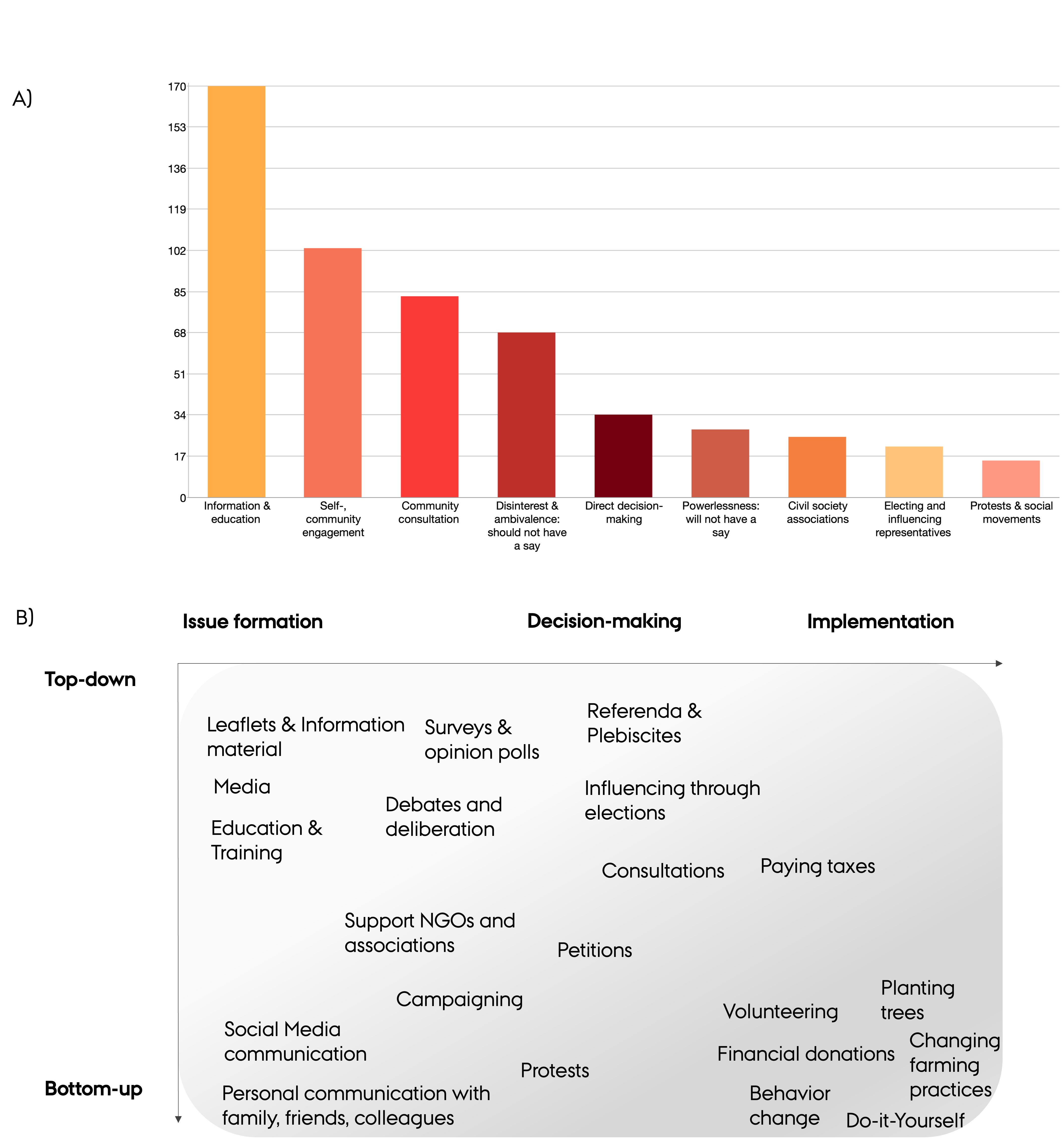
Public preferences for engagement vary depending on the climate technology in question. For biogenic CDR methods such as reforestation and nature restoration, formats that encourage and facilitate active and practical engagement in local implementation and deployment efforts are called for.
For novel CDR methods such as DACCS, BECCS and to a lesser extent Enhanced Rock Weathering, community consultation and public involvement in government-industry decision-making on infrastructure siting, transportation, and carbon storage as well as in the design and risk management of initial demonstration projects, are central.
For SRM approaches like Stratospheric Aerosol Injection public participation in decision-making about whether these approaches should be considered are strongly called for by some, and vehemently opposed by others. Under conditions of such uncertainty and polarization, there is a need to create global spaces for deliberation and debate.
A variety of rationales underpin participants’ narrations of why publics should or should not participate in and be engaged with climate technologies. Public engagement is considered desirable for instrumental (e.g., increasing acceptance, securing support and reducing opposition and conflict), normative (e.g., those affected should have a right to express their opinions) and substantial reasons (e.g., specific local knowledge can improve decisions about implementation and reduce potential trade-offs). At the same time, some participants are skeptical about public engagement. The complexity and technicality of climate technologies, and the lack of publics to sufficiently comprehend their implications, is by far the most discussed rationale underpinning caution on (direct) public involvement in governance. This rationale is coupled with expressions of high trust in experts and governments to take well-informed and well-intentioned decisions. Furthermore, participants across focus groups – though most strongly in European, democratic, countries – express concerns about the inefficiency or even impossibility of decision-making with strong public involvement. Procedural concerns play a considerable role in publics’ considerations.
We also heard numerous accounts of disillusion and feelings of powerlessness as well as narrations of not being heard when powerful vested interests are at play. Developing inclusive public engagement with emerging climate technologies necessitates a critical interrogation of past and present forms of exclusion and power dynamics in decision-making processes.
Adopting power-sensitive practices also means acknowledging and tackling unequal opportunities to engage as well as recognizing that some publics might not want to engage actively with such emerging technologies and prefer to delegate tackling questions surrounding them to either elected representatives or to those perceived as experts, hence expressing preferences for clear divisions of roles and responsibilities between different stakeholders.
Read more how publics think about their own role and the 7 key consideration for public engagement with climate intervention technologies here.
References
Fritz, L., Baum, C.M., Low, S., Sovacool, B.K. (2024)
Nature Communications
Chilvers, J., Bellamy, R., Pallett, H. & Hargreaves, T. (2021)
Nat. Energy 6, 250–259