
- Research funding for carbon dioxide removal (CDR) grew rapidly over the past three decades but is lower than funding for carbon capture and storage (CCS).
- CDR funding is highly concentrated in North America and Europe; Global South countries are underrepresented.
- Funding focuses on natural, agricultural, and engineering sciences, with small, but increasing shares for social sciences.
- Organizational collaboration on grants is low compared to CCS and clean-tech and Global North research organizations dominate CDR collaboration networks.
- CDR research primarily relies on general funding instruments. Targeted funding programs could help to boost innovation in CDR.
Achieving the Paris Agreement target necessitates not only aggressive emission cuts but also the rapid scaling of Carbon Dioxide Removal (CDR) technologies, as experts and scientists concur. To transition from early development of novel CDR options such as Direct Air Capture and Storage (DACCS) or Bioenergy with Carbon Capture and Storage (BECCS) to large-scale deployment, a robust and strategically funded research and innovation ecosystem is crucial.
In our recent study, we investigated global funding patterns in CDR research, seeking to understand where the money flows, who receives it, and what this implies for innovation policy. Our approach utilized machine learning to analyze over 6,000 research grants across 12 different CDR options, providing a comprehensive view of CDR funding. Here’s what we found:
1. A surge in CDR funding, but still trailing behind CCSResearch funding for CDR has increased substantially over the last three decades, growing 21% annually in funding and 17% in active grants (1990-2023). This growth surpasses that of general climate science and clean-tech funding, highlighting CDR's emerging importance in mitigation. The last decade also saw diversification across CDR options, with biochar, BECCS, and DACCS gaining traction. However, CDR's total estimated funding of $4.2 billion lags Carbon Capture and Storage (CCS) ($4.9 billion). Individual CCS grants receive more than triple the average funding compared to CDR grants. This disparity stems from large CCS demonstration projects, often involving more private sector, particularly fossil fuel company, participation.
We identified a lack of specifically targeted funding for CDR. The vast majority of CDR research originates from general funding instruments and broad calls that do not have a specific strategic or thematic focus on carbon removal. Out of over 700 unique funding schemes we examined, only four could be explicitly identified as targeting carbon management or carbon removal research. This suggests that CDR research has not yet emerged as a strategic research priority.
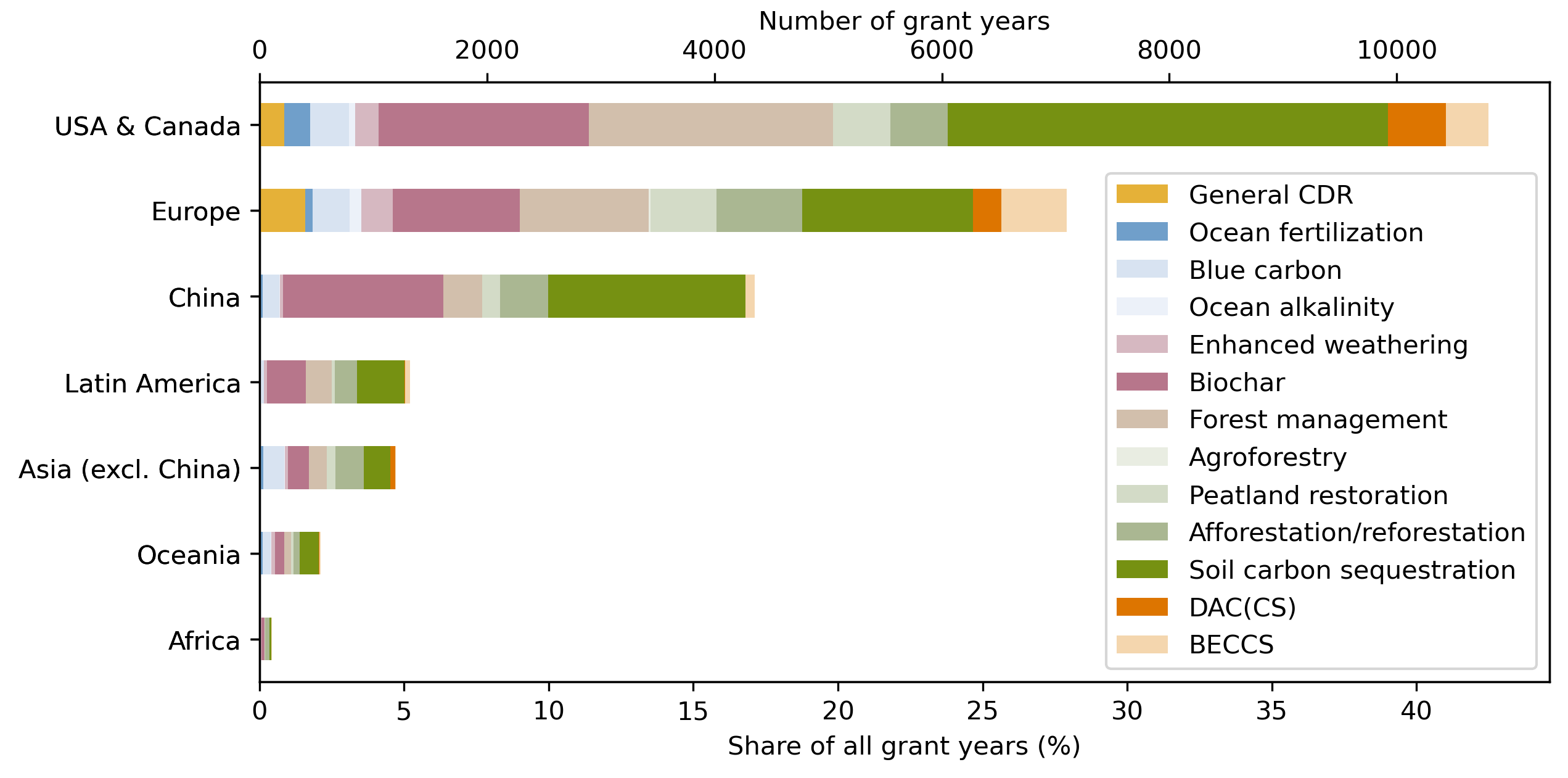
3. Geographical divides in funding allocationCDR research funding is highly concentrated in the Global North. Institutions in North America receive 43% of grant years, followed by European countries (28%), and China (16%). In contrast, Global South countries (Africa 0.4%, Latin America 5.2%, other Asia 4.6%) are significantly underrepresented. These unequal patterns mirror broader climate and clean technology funding disparities. We also found some regional specialization (e.g., North America for soil carbon and DACCS, China for biochar, and Europe for BECCS).
When examining the disciplinary distribution of CDR research funding, the vast majority of grants are attributed to natural sciences (56% of grant years), agricultural sciences (52%), and engineering science (13%). Social science (11%) and humanities (0.5%) research on CDR receive a comparatively small fraction of funding. While the share of social science funding has increased over the last 15 years, it often appears as an instrumental component within larger, technology-focused projects, often involving tasks like capacity building and stakeholder engagement. This suggests social science is sometimes conceived as a facilitator for technology implementation, rather than an integral part of understanding CDR's complex societal and political dimensions.
5. Low levels of collaboration with centers in the Global NorthOur network analysis revealed that collaboration among organizations on CDR grants is relatively low, with only 13% of grants listing more than one receiving organization. This is notably lower than for CCS grants (20%) and clean-tech (23%). Central and influential research organizations in the network are primarily located in the Global North. Furthermore, private sector involvement in CDR knowledge production is comparatively low, with most cross-sectoral research collaboration focusing on DACCS and BECCS. This contrasts with CCS research, where major oil and gas industry players are central and well-connected.
Recommendations for future CDR research fundingOur findings provide a crucial basis for setting future priorities for public and private investments in the CDR research and innovation system. To accelerate innovation responsibly and equitably, we recommend that policymakers reorient funding patterns in several key ways:
- Establish strategic partnerships: We suggest that funders consider creating strategic partnerships and targeted funding calls for collaborations with low- and middle-income countries that have high potential for specific CDR options, focusing on knowledge transfer and capacity building.
- Prioritize interdisciplinary challenges: Funding calls should focus on interdisciplinary challenges and problems, rather than single technologies in specific disciplines.
- Boost collaboration: targeted funding towards collaborations between research organizations and across disciplines could foster faster learning, as current collaboration is comparatively low.
- Increase social science funding: We think that increasing funding for social science research on CDR through targeted programs is crucial for addressing societal questions related to financing, regulation, and designing effective public engagement for responsible CDR deployment.
Our research is a first step towards a better understanding of the broader CDR innovation system and of the enabling and disabling factors for successful CDR technology development and innovation policy.
References
Müller-Hansen, F., Fritz, L., Lück, S., Sovacool, B. K., & Minx, J. C. (2025)
Environmental Research Communications, 7(9), 095008.