
- This dataset is the outcome of a global survey exercise exploring public perceptions and support of climate-intervention technologies in 30 countries (and 19 languages).
- This survey exercise was designed to provide data that would serve as the first global-level baseline of public perceptions on climate-intervention technologies.
- The dataset helps to understand how perceptions and levels of support differ by technology.
This dataset is the outcome of a global survey exercise exploring public perceptions and support of climate-intervention technologies in 30 countries (and 19 languages). Climate-intervention technologies were classified into two categories: carbon dioxide removal and solar radiation modification. Consideration of climate interventions is growing, given the increasing severity of climate impacts and insufficient pace of emissions reductions. This survey exercise was designed to provide data representing the first global-level baseline of public perceptions of climate interventions – and insights into how these vary by technology and across countries. Also, by asking about factors like beliefs and experience with climate change and trust in responsible institutions, it is possible to examine how these interact with public perceptions. Data collection was administered online between August and December 2022, resulting in a final sample of N=30,284 participants (at least 1,000 in each country). Survey samples were nationally representative of country populations (18-74) in terms of age, gender, country region, geographic area and broad quotas for education and income
Growing consideration of different techniques for climate intervention, their prospective uses, or potential consequences and trade-offs has predominantly taken place among researchers and policy-makers – most of all in a handful of countries across the Global North. As a result, there is little understanding of and engagement with global publics, certainly not to the extent that would enable a proactive discussion of the opportunities, challenges, or concerns posed by climate-intervention technologies.
For this reason, this survey exercise was designed to provide data that would serve as the first global-level baseline of public perceptions on climate-intervention technologies. This aim was achieved using surveys conducted in 30 countries and 19 languages, with a final sample of N=30,284 participants. Since such technologies remain broadly unfamiliar – something also confirmed by the dataset – the available data provides broad insights into how publics appear to perceive carbon dioxide removal (CDR) and solar radiation modification (SRM) technologies at present.
As a second aim, the dataset helps to understand how perceptions and levels of support differ by technology. This was achieved by asking participants to evaluate specific technologies, ten in total (7 CDR and 3 SRM), which were grouped into categories of three or four broadly similar technologies. These categories reflected broad groupings of conventional CDR (afforestation and reforestation, soil carbon sequestration, and marine biomass and blue carbon), novel CDR (direct air capture with carbon storage, bioenergy with carbon capture and storage, enhanced weathering, and biochar), and SRM (stratospheric aerosol injection, marine cloud brightening, space-based geoengineering). Participants were randomly assigned to one of these groups and presented with short information texts related to the three or four technologies. Using several questions about the perceived risks and benefits plus on the level of technology support, we can gather insights on the least versus most preferred options at a cross-country level. Such insights were coupled with questions on support for various policy options – this was assessed by participants for each of the technology categories. Together, such data serves to develop profiles of the perceived strengths and weaknesses of the relevant technologies, the extent to which these are heterogeneous across countries, and indications of the kind of policy architecture which might be viewed as important (or not).
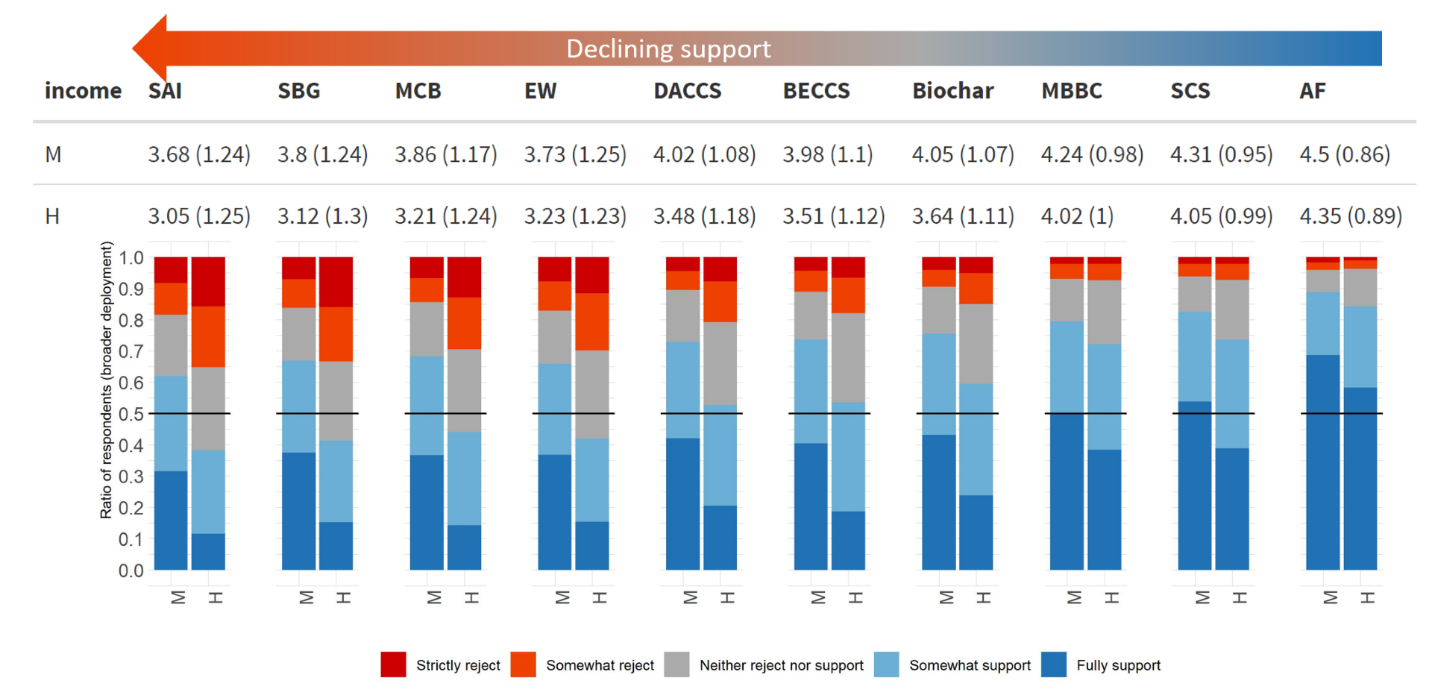
Third and finally, questions on sociodemographic characteristics, beliefs about climate change and environment, and trust in institutions and actors and credibility of sources of information, among others, facilitate exploration of how public perceptions and support of climate-intervention technologies is influenced by these other factors. In all these respects, this global-level survey dataset offers wide-ranging insights into where publics around the world currently stand in relation to their perceptions and support of these nascent, and often not well-understood, climate-intervention technologies.
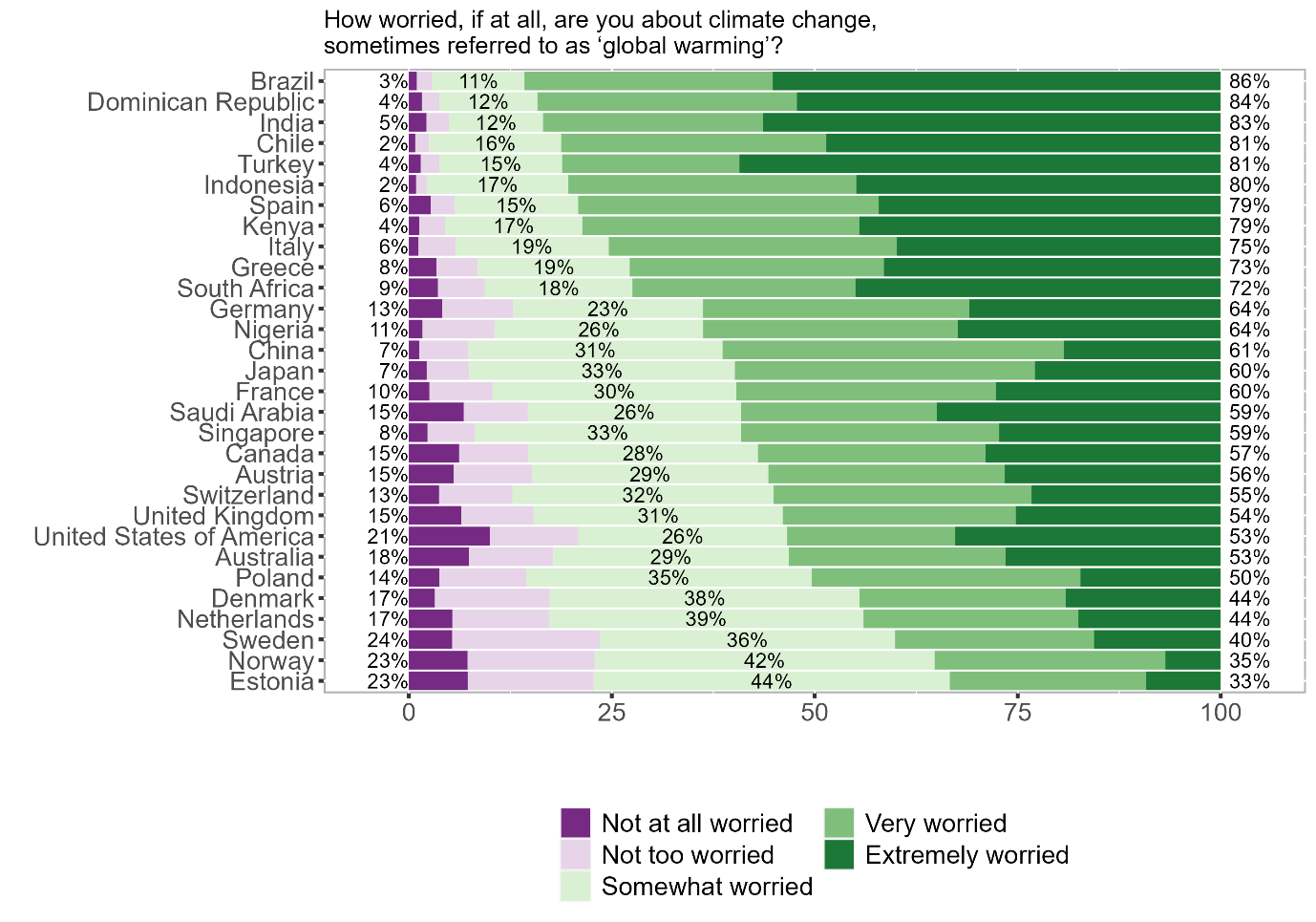
The full dataset, along with the final survey instrument and additional information, is available in the Open Science Framework (OSF) repository. The dataset consists of 377 variables and 30,284 cases, with detailed label information. The repository also includes the final English version of the survey instrument for reference. Additionally, responses to an open-ended question from six countries are provided separately due to transcription issues.
References
Brutschin, E., Baum, C.M.,Fritz, L.,Low, S., Sovacool, B.K, Riahi, K. (2024)
Environmental Research Letters, 19(11)
Baum, C.M., Fritz, L.,Low, S., Sovacool, B.K (2024)
Nature Communications,15(1), 2060