Drivers and attitudes of public support for technological solutions to climate change in 30 countries
Author(s):
Brutschin, E.,Baum, C.,Fritz, L.,Low, S.,Sovacool, B.,Riahi, K.
Institution:
International Institute for Applied Systems Analysis (IIASA)
Date:
January 2025
Regional Resolution:
30 Countries
Public support
Climate change
Key Insights
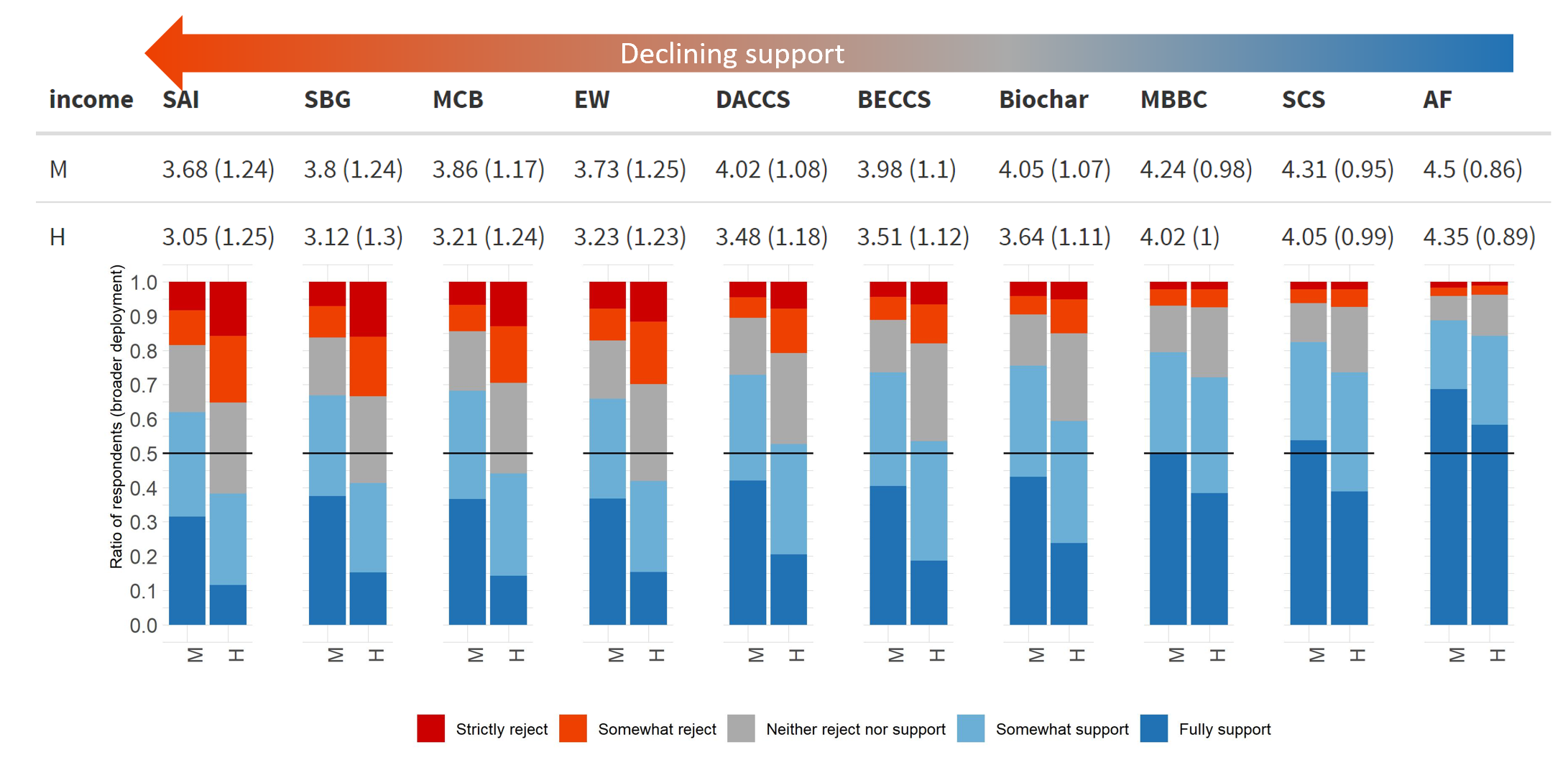
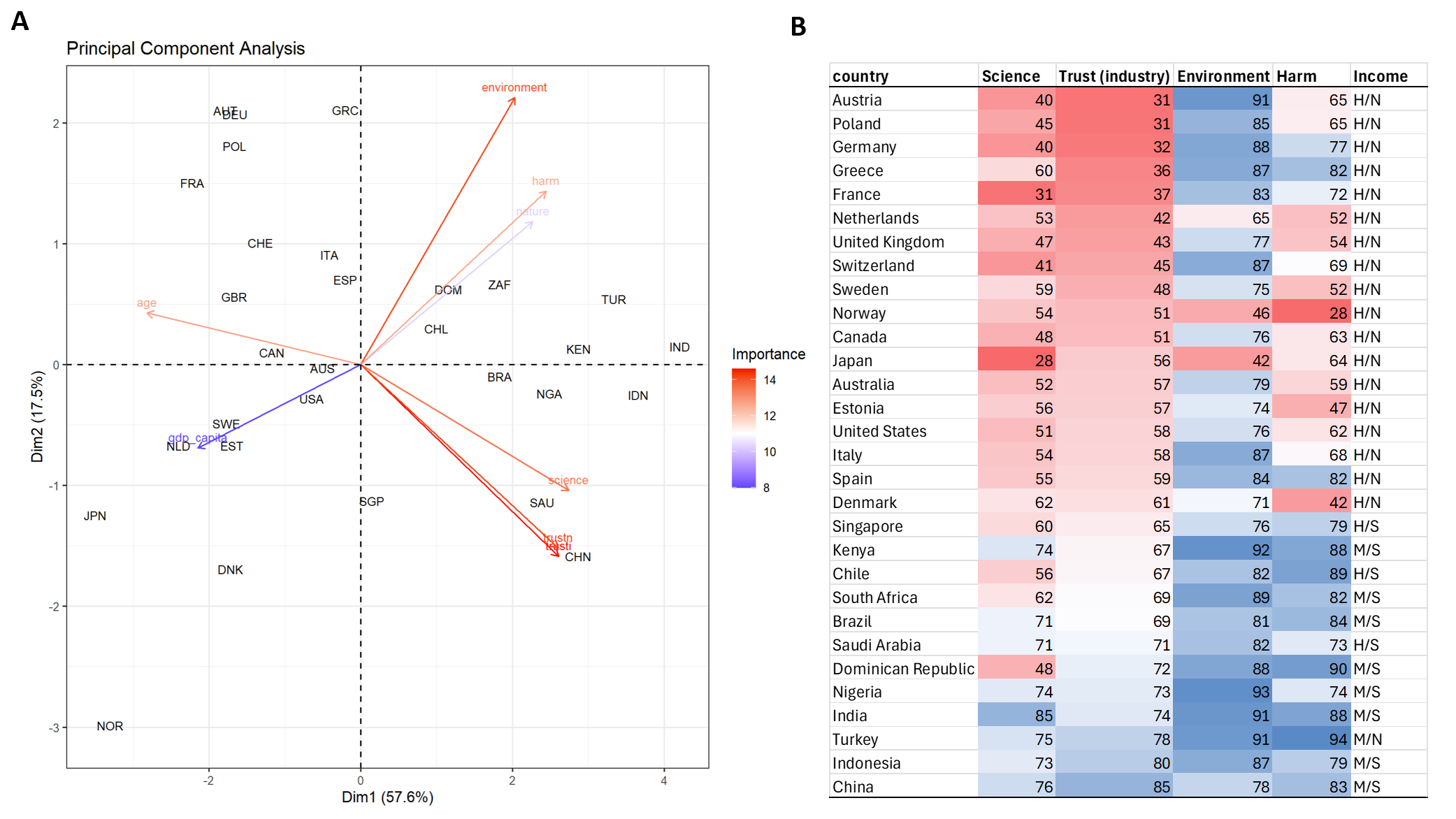
Wealthier countries exhibit greater skepticism toward CDR and SRM technologies, in combination with lower trust in science and industry to find solutions to climate change
Middle-income countries display higher support for these technologies but may lack the infrastructure and governance capacity to implement them effectively
Technologies that are perceived to be more nature based have higher levels of reported support
This study provides a comprehensive analysis of public perceptions of Carbon Dioxide Removal (CDR) and Solar Radiation Modification (SRM) technologies across 30 countries, utilizing data from over 30,000 respondents. The research examines key factors influencing public support, highlighting the divergence between wealthier and middle-income nations, and across the different technologies.
Figure 1: Overview of support for deployment different technologies across 30 countries (N=30,284 respondents): SAI= Stratospheric aerosol injection, SBG= Space-based geoengineering, MCB= Marine cloud brightening, EW=Enhanced weathering, DACCS= Direct air capture with carbon storage, BECCS= Bioenergy with carbon capture and storage, MBBC= Marine biomass and blue carbon, SCS= Soil carbon sequestration, AF=Afforestation. The countries are categorized into different income groups based on World Bank’s classification (latest available year): M=lower middle-income+upper middle-income, H=high income. The table reports the mean and standard deviation in brackets for each income group and technology. High income countries include Saudi Arabia, Denmark, Singapore, Greece, Sweden, Estonia, Chile, Spain, Italy, Norway, Netherlands, Australia, United States, Canada, United Kingdom, Poland, Switzerland, Austria, Germany, France, and Japan, while upper middle income countries are China, Turkey, Brazil, South Africa, and Dominican Republic, and lower middle income countries are India, Kenya, Nigeria, and Indonesia. Drivers of Skepticism in Wealthier Nations:
Lower perceived risk from climate change due to better adaptive capacity
Limited belief in technological solutions to effectively address climate challenges
Limited trust in industry
Figure 2: Key social and environmental explanatory factors for all countries included in the survey of CDR and SRM. In Panel A, the results of an explanatory principal component analysis are displayed showing the loading of variables for individual countries, including World Bank Indicators such as GDP per capita and age (share of population above 65 years). The position of each point indicates the score on the principal components, while direction and length of the vectors indicate the contribution of the variables to the principal components. Longer arrows suggest stronger contributions. Panel B displays the share of respondents for a given country that indicated agreement on the Likert scale for a subset of items that stood out based on the analysis in Panel A. “Science” relates to the question: “To what extent do you agree with the following statement about science: Science and technology will eventually solve our problems with climate change” (Scale 1-5), “Trust” in industry relates to the question “How much trust do you have in the following groups and institutions, when it comes to their responsibility [and ability] to use these technologies to limit the effects of climate change?” (Scale 1-6), “Environment” relates to “I think of myself as someone who is concerned about the environment” (Scale 1-7), “Harm” relates to the question “How much do you think climate change will harm you personally? (Scale 1-4). In the “Income” column, we additionally indicate the classification of countries based on the World Bank's criteria and the Global North ('N') and Global South ('S') classification as used in the study by Baum et al. (2024). Influencing Factors Across All Regions:
Higher support is associated with strong biospheric values (e.g., caring for nature).
Familiarity with technologies positively influences public acceptance.
Socioeconomic variables like age, education and religion also shape attitudes but their effect is context dependent
Risks of Unilateral Actions:
The potential for unilateral implementation of SRM in regions with higher support poses significant risks, including unintended global or regional climate impacts.
Implications for Policy and Governance
Tailored Strategies: Policymakers need context-specific approaches to account for regional differences in technological acceptance and implementation capacity.
International Collaboration: The study emphasizes the importance of global governance frameworks to prevent unilateral deployment of SRM technologies. International cooperation should also include technology transfers and financial assistance to middle-income countries.
Public Engagement: Addressing public skepticism in wealthier nations requires transparent communication about the benefits and risks of CDR and SRM. Efforts to improve public trust in science and industry are critical.
Conclusion
This research underscores the importance of integrating public perceptions into climate policy design. A nuanced understanding of regional attitudes can guide effective, equitable, and sustainable deployment of climate technologies, while highlighting the need for robust international governance to manage shared risks and responsibilities.