
- Deploying CDR options at the urban scale could make a significant contribution to global mitigation of climate change.
- Urban CDR options considered include the storage of carbon in urban vegetation, soils and buildings, and the capture of CO2 from indoor environments via decentralised direct air capture
- Storing C in urban areas could also support the upscaling of climate action from local to regional and national scale, as well as go hand in hand with potentially large mitigation and adaptation co-benefits
- Key knowledge gaps and future research avenues are centred around the need for additional field deployments, consideration of the particularities of different urban geographies and socio-economic contexts, and the establishment of robust cross-sectoral carbon accounting methodologies.
The vital role of urban areas in climate change mitigation is increasingly recognised and reflected by the pledges of over 1000 global cities committing to achieve net-zero emissions in the coming decades. With the aim of supporting the path to achieving net-zero emissions in cities, the authors assessed the existing literature on Carbon Dioxide Removal (CDR) at the urban scale, seeking to quantify the potential negative emissions contribution of cities globally.
Urban CDR options considered here include the storage of carbon in urban vegetation, soils and buildings, and the capture of CO2 from indoor environments via decentralised direct air capture. The authors also reflected on surface albedo increase as an urban-specific measure that, despite not contributing to carbon sequestration, is here considered due to its associated co-benefits in mitigating urban heat islands and lowering building energy consumption.
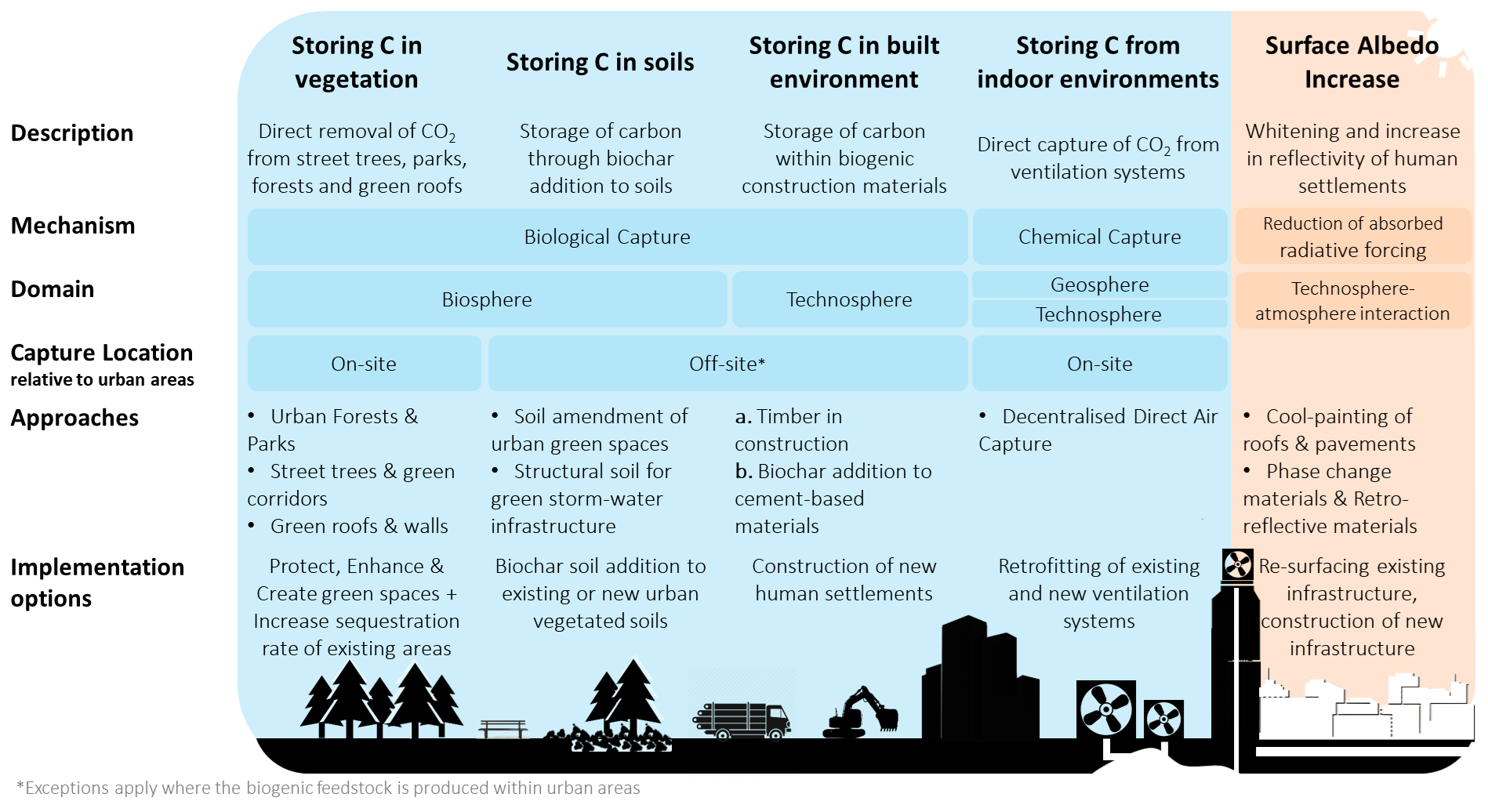
Estimates of carbon storage and capture potentials indicate that deploying CDR options at the urban scale could make a significant contribution to global mitigation of climate change, alongside supporting the upscaling of climate action from local to regional and national scale. The author’s assessment suggests that a portfolio of urban CDR options that includes C storage potentials from vegetation, soils and the built environment, as well as the capture potential for direct air capture in ventilation systems, is possible in the range of up to 1 GtCO2/year.
Extending beyond this carbon-centric perspective, the deployment of a portfolio of CDR options at the urban scale is also associated with potentially large additional climate change and urban heat island mitigation and adaptation co-benefits. For instance, urban vegetation ‘s higher evapotranspiration could reduce urban ambient temperatures, as well as providing green spaces associated with enhanced human physical and psychological health. Capturing CO2 from indoor environments could simultaneously improve air quality in buildings, and biochar production from municipal waste could foster an urban circular bio-economy.
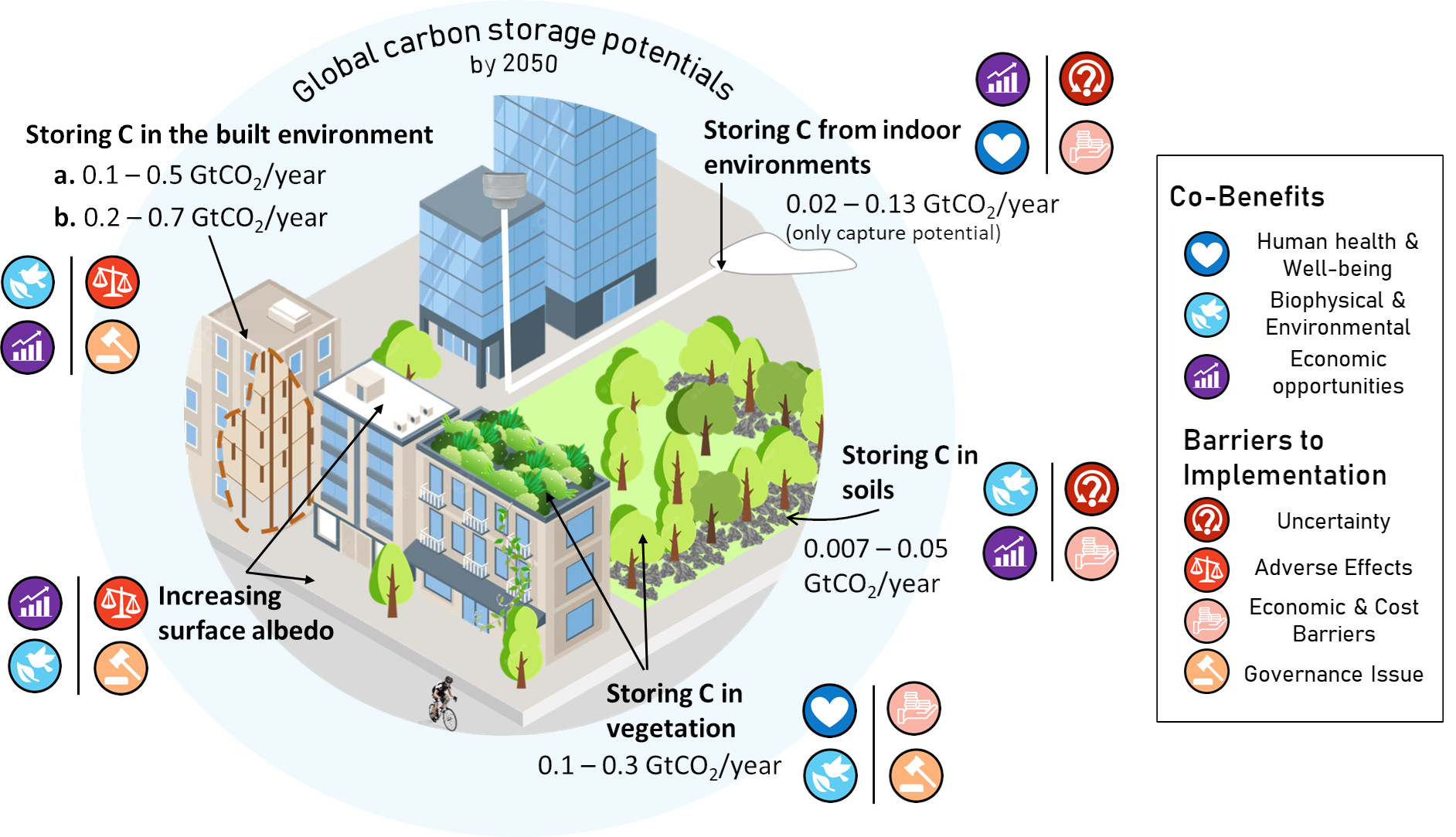
Any upscaling of the reviewed technologies is nevertheless constrained by several uncertainties, economic barriers and governance issues that pose substantial challenges to their implementation. These range from potential low public acceptance and high costs of the selected implementation options, limited availability of space for urban greening, or logistical bottlenecks for the transportation and storage of CO2 captured from ventilation systems. From these, the authors identified key research gaps and recommendations for future research centred around the need for additional field deployments, consideration of the particularities of different urban geographies and socio-economic contexts, and the establishment of robust cross-sectoral carbon accounting methodologies.
References
Rodriguez Mendez, Q., Fuss, S., Lück, S. & Creutzig, F. (2024)
Nature Cities
Rodriguez Mendez, Q., Fuss, S., Lück, S. & Creutzig, F. (2024)
Nature Research Briefing