
- Our new study provides an inventory and taxonomy of almost 400 co-benefits, challenges, and limits for six land-based carbon dioxide removal (CDR) options based on literature evidence.
- The mapping of the literature shows relatively comprehensive evidence in Europe but little research on side effects across Africa and South America, even though large-scale land-based carbon removals are expected to occur in these regions in many scenarios.
- Magnitude and desirability of identified side effects are strongly context-dependent and vary depending on the mode of implementation, location, and time.
- Our study provides entry points for future research to further investigate side effects to maximize benefits and minimize disbenefits of CDR.
The use of land-based CDR for climate change mitigation will come along with an array of environmental, socio-political, and economic implications – many of which have not yet been sufficiently understood, e.g., in the context of impacts on the natural cycling of nutrients and minerals or distributional consequences. While large-scale CDR will likely evoke undesired side effects, scientific evidence shows that side effects are highly context-dependent and vary depending on many factors, including the mode of implementation, deployment scale, and location. Research also shows the potential for co-benefits of CDR if carefully and sustainably implemented, e.g., enhancing wildlife by restoring degraded forests.
The growth in research on proposed CDR options and their potential side effects helps us to understand better how removals can be part of the solution while avoiding conflict with other policy goals such as sustainable development and eradicating poverty. However, when evidence is scattered and growing rapidly, it can become challenging to keep a good overview, especially when different strands of evidence seem contradictory at times.
In our new study, we address this issue by systematically mapping the recent peer-reviewed scientific literature evidence on co-benefits, challenges, and limits for six land-based CDR options, namely afforestation and reforestation, bioenergy with carbon capture and storage, biochar, direct air capture with carbon capture and storage, enhanced weathering, and soil carbon sequestration. These options currently dominate the discussion on land-based CDR and are increasingly incorporated in the models that scientists use to explore the shrinking solution space for climate change mitigation that would still allow us to limit global warming in line with the Paris Agreement.
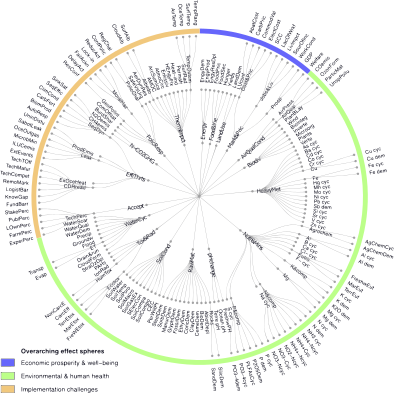
As part of our study, we created an inventory of almost 400 side effects of CDR, which we found in the literature, and we structured these effects in a literature-based taxonomy, as shown in Figure 1. These identified effects can at least partly be both positive or negative, depending on the context, including the mode of implementation, deployment scale or location.
We also find that the scientific evidence on CDR side effects is unevenly distributed geographically. While there is comprehensive research on CDR side effects in Europe, much less research currently exists for Africa and South America – acknowledging that our mapping study is restricted English language research. Such a potential evidence gap would be problematic as the aforementioned models assume a large share of land-based CDR to take place in these two regions, which calls for a better understanding of potentially negative implications. Ultimately, our study provides entry points for future research to investigate side effects further. Such knowledge can help us to use CDR in a way that holistically maximizes co-benefits and minimizes undesired implications.
References
Prütz, R., Fuss, S., Lück, S., Stephan, L., & Rogelj, J. (2024)
Communications Earth & Environment